


March 03, 2026
0 comments


If you slice the golf ball, you have almost certainly been told to swing more to the right. Or strengthen your grip. Or aim left and play the curve. These are band-aids on a broken bone. They might reduce the symptom for a few swings, but they never eliminate the cause.
The reason is straightforward: most slices are not caused by swing path. They are caused by a clubface that is open to the path at impact. And the most common reason the clubface is open is a cupped lead wrist — a breakdown in the back of your left hand (for right-handed golfers) that opens the face and sends the ball curving right.
Why Swing Path Is Not the Problem You Think It Is
Launch monitor data has made one thing clear: the clubface accounts for roughly 75-85% of the ball's starting direction. Path influences the curve, but the face determines where the ball starts. A golfer with an open clubface and a perfect in-to-out path still hits a push-slice. A golfer with a square face and an over-the-top path hits a pull — straight, just left of target.
Which miss would you rather have? The pull is playable. The slice is not, because the open face bleeds distance, adds spin, and creates a curve that compounds with every yard of carry. You can reroute your swing all day, but if the clubface is still open at contact, the ball still slices.
The Cupped Wrist: Where the Open Face Comes From
Your lead wrist controls the clubface. When the back of your left hand cups — bends backward, away from the target — the face opens. When it stays flat or slightly bowed, the face stays square. This relationship is mechanical and absolute. The geometry does not allow a cupped wrist and a square face simultaneously.
Most golfers cup the wrist without knowing it. The motion happens during the downswing transition, when the body is moving fast and conscious control is impossible. The impact interval lasts four thousandths of a second. You cannot think your way to a flat wrist at that speed. You have to train it until it happens automatically.
Why Grip Changes Alone Do Not Solve It
A stronger grip can mask a cupped wrist temporarily by pre-setting the face in a more closed position. But you have not fixed the breakdown — you have just given yourself more room to break down before the slice appears.
Worse, this approach trades one miss for another. Strengthen the grip further and you start hitting hooks. Now you have two-way misses — slices when the wrist cups too much, hooks when the strong grip overcorrects — and no idea which is coming. The only lasting fix is training the wrist to stay flat through impact as an automatic motor pattern.
How Tactile Feedback Eliminates the Root Cause
A cupped wrist feels normal to the golfer who has been swinging that way for years. Your proprioception has calibrated "cupped" as "neutral," and no amount of mental intention will override that calibration. You need external feedback — something physical that makes the difference between flat and cupped unmistakable on every rep.
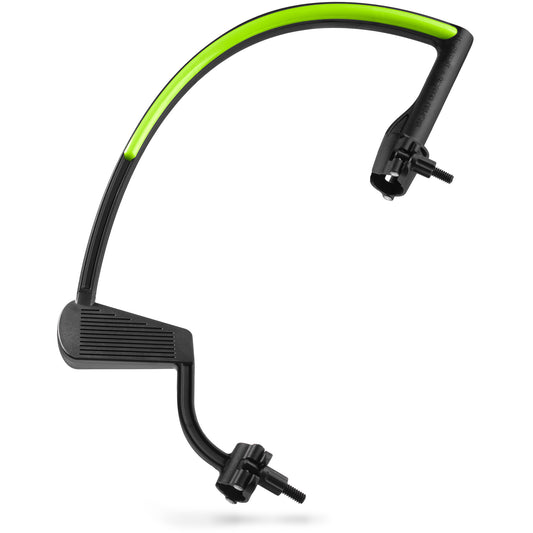
That is the principle behind theHANGER. It attaches to your club and gives you real-time tactile feedback on your lead wrist position throughout the swing. You do not guess whether your wrist is flat. You feel it. That immediate, unmistakable feedback transforms a conscious correction into an automatic motor pattern — the kind that holds up under pressure.
What Changes When the Face Is Square
Golfers who fix the open face at its source report a consistent set of changes:
- The slice disappears, replaced by a straight ball or slight draw
- Distance increases immediately, because a square face delivers energy more efficiently
- Ball flight becomes lower and more penetrating, more controllable in wind
- Confidence off the tee improves, because the two-way miss is gone
You do not need a new driver. You do not need a swing overhaul. You need the clubface square at impact, and that starts with the lead wrist. Fix the wrist, and the slice fixes itself.


