


November 03, 2025
0 comments


Every golfer knows the feeling of a purely struck iron. The contact is solid but almost silent. The ball bores through the air instead of floating. The divot starts at the ball and extends toward the target. For most mid-handicappers, it happens just often enough to be tantalizing but not often enough to be reliable.
The difference between consistent ball strikers and golfers who alternate between fat and thin shots is one mechanical fact: where the club reaches the bottom of its arc.
What Ball-First Contact Actually Means
When a tour professional hits an iron, the clubhead is still descending when it meets the ball. It does not reach the lowest point of its arc until an inch or two past the ball. This produces the ball-first, turf-second contact sequence — compression, spin, and that penetrating flight.
This is not intuitive. Every instinct tells you to time the lowest point to coincide with the ball's position. But when you do that, any slight miscalculation produces a fat shot (ground before ball) or a thin shot (arc bottoms out early, leading edge catches the ball rising). When the low point is consistently past the ball, you have margin for error — the ball is always on the descending side of the arc.
The Two Variables That Control Low Point
Weight Position
At impact with an iron, your weight should be slightly forward — roughly 55-60% on your lead foot. This shifts the low point past the ball. When weight stays back during the downswing, the low point moves behind the ball and you hit it fat. When weight lurches too far forward, you steepen excessively and catch the ball thin.
Spine Angle
This is the variable most golfers overlook. Your spine angle at address — the forward tilt of your upper body — establishes the radius of your swing arc. If that angle changes during the swing, the arc changes. Stand up through impact and the club passes over the ball (thin). Dip toward the ball and the club buries into the ground behind it (fat).
These two variables are directly related: a stable spine angle produces a consistent arc bottom. An unstable spine angle makes it unpredictable — and unpredictable contact is the definition of inconsistency.
Why Fat and Thin Shots Come in Pairs
If you struggle with fat and thin shots, you have probably noticed they alternate. You hit one fat, overcorrect, hit the next one thin. This is not randomness — it is the logical consequence of an unstable low point.
A fat shot tells your body to "get higher" on the next swing. You stand up slightly and hit it thin. That thin shot tells your body to "stay down," so you dip — and catch it fat again. You are oscillating around an unstable center, and no amount of conscious effort stops the cycle because the adjustments happen too fast for deliberate control.
The fix is not trying harder to stay down or stand up at the right moment. The fix is training your body to maintain a consistent spine angle so the low point stays in the same place on every swing.
How to Train Consistent Low Point
Maintaining spine angle is not about being rigid. Your body rotates, your weight transfers, your arms extend. The spine angle simply stays constant as all of that motion happens around it — a fixed axis the rest of your body rotates around.
The challenge is that you have no natural feedback mechanism for spine angle. You cannot see it during the swing, and feel alone is unreliable — especially under pressure, when the tendency to stand up is strongest.
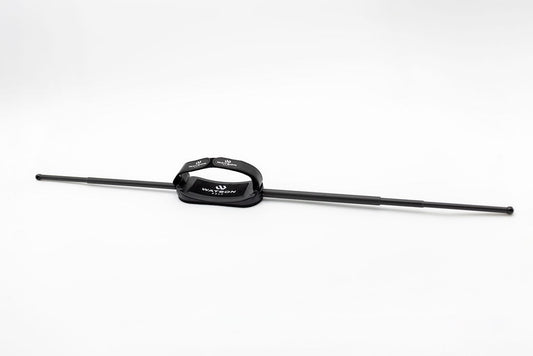
theTILTSTICK was designed to solve this. It provides real-time physical feedback on spine angle and rotation throughout the swing, so you feel immediately when your posture breaks down. That feedback, repeated over dozens of practice swings, trains your body to hold the position automatically — even when the pressure is on.
Your divots will tell you when you have it. A consistent divot that starts at the ball and extends forward means the low point is in the right place. That is not luck. It is geometry.


