


September 15, 2025
0 comments


The slice gets all the attention, but the hook — particularly the low, diving snap hook — is the more destructive miss. A slice is predictable. A hook is violent.
If you have developed a hook, there is a strange irony at work: you have probably gotten better. The hook is often a sign that your swing path has improved and you are delivering the club more from the inside. The problem is that the clubface did not keep up. It is closing too fast relative to the path, and the result is a ball that starts right and dives left.
The Physics of a Hook
Ball flight is governed by two factors: the direction the clubface is pointing at impact (face angle) and the direction the club is traveling (swing path). When the face is closed relative to the path, the ball curves left for a right-handed golfer. A draw happens when the face is slightly closed to the path — maybe 2-3 degrees. A hook happens when that gap widens to 5, 8, or 10 degrees and the ball dives hard once sidespin takes over.
The hook is not a swing path problem. It is a face control problem.
Why the Face Closes Too Fast
Three common causes, often working together:
- A grip that is too strong. When both hands are rotated too far to the right on the club, the face naturally returns to a closed position at impact. The stronger the grip, the more the face wants to shut. You are fighting geometry every time you swing.
- Excessive forearm rotation through impact. Some golfers actively roll their forearms through the hitting zone, either from old instruction or from overcorrecting a slice. This rotation closes the face rapidly and unpredictably.
- Loss of lead wrist structure. When the lead wrist cups or the trail hand overtakes it through impact, the clubface snaps shut. The hands are moving faster than the body, and the face pays the price.
Why Feel Alone Cannot Fix It
Here is the difficulty: the swing that produces a hook often feels good. The path is solid, contact is decent, and the ball starts on line before diving left. You cannot feel the three or four degrees of closure that separate a draw from a duck hook. As Bobby Jones observed, feel is the golfer's only real guide — but feel has to be calibrated. An uncalibrated sense of face angle is like a compass that points five degrees off north.
Training Face Awareness
The fix for a hook is not a swing thought like "hold off the release" or "keep the face open." Those band-aids create new problems — blocks to the right, tension in the forearms, loss of speed. The real fix is developing a precise awareness of where the clubface is throughout the swing, particularly from waist-high on the downswing through impact. When you can feel the face, you can control it. When you cannot feel it, you are guessing.
A Structured Approach
If you are fighting a hook, work through this sequence:
- Check your grip. Weaken it slightly — rotate both hands toward the target until you can see only two knuckles on your lead hand at address. This changes the face's default position at impact.
- Slow down. Hit half-speed shots and focus on maintaining a flat lead wrist through impact. The wrist should not cup, bow excessively, or roll over before the ball is gone.
- Train with feedback. Use a device that tells you what the clubface is doing so you can match the feel to the reality. Over time, the correct position becomes instinctive.
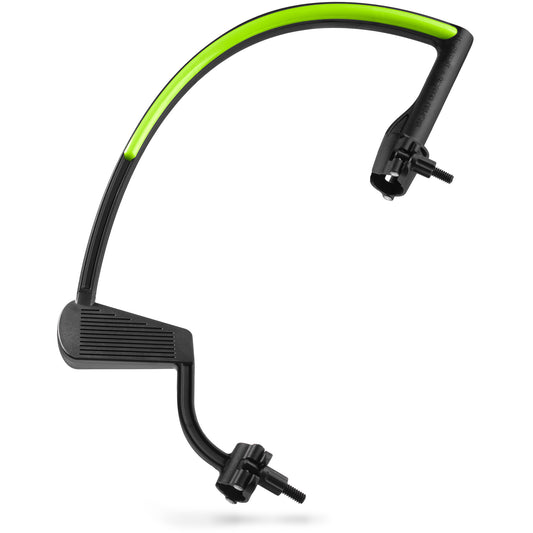
theHANGER was built for exactly this kind of face-awareness training. It provides unmistakable physical feedback on clubface orientation throughout the swing, so you know — not guess — whether the face is open, closed, or square. For the golfer fighting a hook, that feedback is the fastest path from a destructive miss to a reliable, controlled draw.
The hook and the slice are opposite symptoms of the same issue. Fix the clubface, and both disappear.


